Holistic Therapy

This selection of treatments is designed to support your overall wellbeing — calming the mind, easing tension, and helping you feel more balanced from the inside out.
NEW FOR 2026: Wood Therapy (maderotherapy)
Reflexology – Indian head Massage – Hope Ear Candles – Skin Tags, Moles, Milia, Birthmarks and vein removal – Electrolysis
Reflexology
Reflexology Intial Treatment: 1 hour 15 mins, Cost £70
Reflexology: 30 mins, Cost £35
Reflexology: 60 mins, Cost £55
Reflexology Course of 6 (30 mins sessions): Cost £175
Reflexology Course of 6 (60 mins sessions): Cost £275
Incorporate Hot Stones into your Reflexology session: 30 mins, Cost £10
Reflexology is a holistic therapy working on the body, mind and soul to generate a healing response in the body.
Reflexology treatments work on specific reflex points in certain parts of the body, predominantly the hands and feet to bring about effects on all other physiological and psychological functions. It is a treatment based on ancient therapies dating back as far as 2500 – 2330BC, being first used by the Egyptians, Chinese and American Indians.
Reflexology is a non-invasive treatment, where Clients only need to remove shoes and socks, that can be given in a variety of surroundings and requires little product or equipment. Treatments have steady results that are better achieved over a period of time
Indian Head Massage
Treatment time: 40 mins
Cost: £40.00
Please call the salon to discuss your requirements, get a quote and make your booking.
Massage has always featured very heavily in the Indian traditions. All the family would play key roles in administering massage and so every member could enjoy its benefits.
Head massage was traditionally used by the Indian women as a way of improving and maintaining the condition of their hair. Today the effects of Indian head massage are considered to be much more widespread on the whole body and mind.
The head, neck, shoulders and upper back are worked with firm rhythmical movements, over the client’s clothes, for 40 minutes.
Some of the main benefits of this treatment include…
- Soothing of tension
- Easing headaches and reducing frequency
- Relieving eyestrain
- Restoring concentration and reducing tiredness
- General relaxation
- Increasing movement in the head, neck and shoulders
- Improving hair growth and hair condition
- Improving scalp problems
Indian Head Massage is a versatile, economical and non-invasive treatment.
Hopi Ear Candles
Treatment time: 25 mins
Cost: £30.00
Hopi Ear Candles are named after the Hopi tribe; American Indians respected for their knowledge and experience of healing techniques and their spiritual peace loving lifestyle. Hopi translated means ‘peaceful ones’. Although the techniques used today are derived from the Hopi tribe, thermo auricular therapy dates back centuries when it was used by the Egyptians, Romans and Greeks.
Hopi Ear Candles are handmade structures. They are hollow tubes moulded from natural linen fabric impregnated with honey and powdered Indian medicinal herbs including: – Sage, St Johns Wort and Chamomile.
The treatment of Hopi Ear Candles involves positioning a candle in one of the ears and allowing it to burn to a measured level before gently removing it and extinguishing it in water. The ear is then massaged to stimulate the pressure points on the ear, lymph nodes around the ear and the general blood flow through the ear. The second ear is then worked on in the same way before the entire face is worked on with a pressure point and drainage massage to stimulate the general release of blockages in the sinuses and ears and the flow of lymph and blood.
The benefits of Hopi ear candles include…
•Ear or sinus problems including Sinusitis.
•Irritations in the nose – Rhinitis.
•Soothing effects for over irritability and stress related symptoms.
•Noises and ringing in the ears – Tinitis
•Build up of earwax.
•Revitalisation for certain hearing impairments.
•Pressure regulation for conditions such as: – headaches, migraines, sinusitis and Rhinitis.
•Circulatory problems in the ear.
•Local stimulation to lymph flow and local metabolism.
•Stimulation of energy circulation.
The only contra-indications listed for this treatment include perforated eardrums, where grommets have been inserted or allergies to any of the ingredients in the ear candles.
Hopi Ear Candles and Massage
Incorporating full facial and head massage
Treatment time: 55 mins
Cost: £50.00
Hopi Ear Candles are named after the Hopi tribe; American Indians respected for their knowledge and experience of healing techniques and their spiritual peace loving lifestyle. Hopi translated means ‘peaceful ones’. Although the techniques used today are derived from the Hopi tribe, thermo auricular therapy dates back centuries when it was used by the Egyptians, Romans and Greeks.
Hopi Ear Candles are handmade structures. They are hollow tubes moulded from natural linen fabric impregnated with honey and powdered Indian medicinal herbs including: – Sage, St Johns Wort and Chamomile.
The treatment of Hopi Ear Candles involves positioning a candle in one of the ears and allowing it to burn to a measured level before gently removing it and extinguishing it in water. The ear is then massaged to stimulate the pressure points on the ear, lymph nodes around the ear and the general blood flow through the ear. The second ear is then worked on in the same way before the entire face is worked on with a pressure point and drainage massage to stimulate the general release of blockages in the sinuses and ears and the flow of lymph and blood.
The benefits of Hopi ear candles include…
•Ear or sinus problems including Sinusitis.
•Irritations in the nose – Rhinitis.
•Soothing effects for over irritability and stress related symptoms.
•Noises and ringing in the ears – Tinitis
•Build up of earwax.
•Revitalisation for certain hearing impairments.
•Pressure regulation for conditions such as: – headaches, migraines, sinusitis and Rhinitis.
•Circulatory problems in the ear.
•Local stimulation to lymph flow and local metabolism.
•Stimulation of energy circulation.
The only contra-indications listed for this treatment include perforated eardrums, where grommets have been inserted or allergies to any of the ingredients in the ear candles.
Skin tags, warts , Moles, Milia & Birthmarks and vein removal
Treatment time: 15 mins
Cost: from £80.00 upwards
Known professionally as Telangiectasia, red veins are commonly referred to as broken veins, dilated capillaries, thread veins or naevi.
They are often found on the face and legs although can appear on the chest and rib area- front and back. The appearance is that of a very fine network of red wavy lines that lies at very close to the surface of the skin. They may appear in clusters or individually, some being darker than others. A cluster of the red lines or capillaries can take on the appearance of a spider therefore are often referred to as spider naevi. The condition will differ from person to person. It can be a minor as one capillary in an isolated area or as extreme as capillaries scattered across a larger area.
Where there is normally a scattering of broken capillaries it is generally found that the skin is fairly sensitive and will flush easily.
The treatment consists of a minute pre-packaged sterilised disposable needle that is applied lightly to the surface of the capillary. The low current employed in this treatment is that used in electrical epilation. This current produces a heating effect and when applied to the capillary the structure and its contents coagulate (dries up). The skin then needs to heal allowing the dead skin cells that where involved in this process to push up to the surface of the skin and flake off, (similar to the healing of a small abrasion (the size of a pin prick).
The treatment of warts, skin coloured moles, skin tags, milia (whiteheads) and birthmarks follows the same pattern as that for red veins. Only smaller birthmarks can be treated, anything extensive would need to be referred to a dermatologist.
Clients will need to give a full case history of their skin and any illnesses. This is important to enable the therapist to assess the sensitivity of the skin and adapt the treatment accordingly. Most therapists will expect to give a skin test especially prior to the first treatment, this will ensure the skin reaction can be observed and lets clients know how the treatment feels.
If I have these capillaries treated will they come back?
Once a capillary has been successfully treated (this may take a couple of treatments) it should not return. However it important to realise that should your skin be prone to the formation of these capillaries others may appear after a time. Preventative measures can be taken to try to avoid this.
I have heard that the skin may be scarred from this treatment, is this true?
If the skin is over treated there may be a risk of some skin trauma. However as these capillaries lie superficially in the skin it will take a lot of extra current to cause this trauma especially as the capillaries dry up under very little heat (low current).
How many treatments will it take to remove these capillaries?
This will depend upon the individual. It can range from two treatments to ten depending on the extent of the condition, how the skin heals and the area being treated This is discussed at the initial consultation and you will be advised accordingly.
Is this treatment successful?
Yes on superficial capillaries. Deeper capillaries will not respond to this treatment. The treatment is also very successful on warts, skin tags and milia. Smaller birthmarks can be treated with success and small skin coloured moles.
May need doctor’s consent prior to treatment…
Electrolysis
- Free Electrolysis Consultation: 15 mins
- Electrolysis: 5 mins · £15
Electrolysis: 15 mins · £20
Electrolysis: 30 mins · £30
Electrolysis: 45 mins · £45
Electrolysis: 60 mins · £55
Electrolysis: 90 mins · £80
Electrolysis: 120 mins· £110
Electrical epilation: Diathermy epilation is the permanent removal of unwanted hair using a short-wave diathermy current. This current creates heat, which is delivered to the hair at the root. The heat dries up all the moisture, living cells and blood supply at the root of the hair, thus destroying it.
Each hair grows in a structure known as a hair follicle. The root of the hair sits at the base of this follicle. To target the heat created by the treatment at the root of the hair, a minute probe or needle is inserted into the follicle. Once it is in place, the current is activated for 1 or 2 seconds.
Galvanic epilation is the permanent removal of unwanted hair using a Galvanic current. This current produces a chemical, which is a result of water, salts and a low current mixing at root of the hair. The chemical produced is caustic in effect; therefore it erodes the living cells and blood supply at the root of the hair, thus destroying it.
Again as in Diathermy the therapist will target the chemical created by the treatment at the root of the hair using a minute probe or needle inserted into the follicle. Once it is in place, the current is activated for 10 – 20 seconds. Do not be alarmed with the term ‘needle’, these are supplied in measurements ranging between thousandths of an inch, therefore can only just be seen by the naked eye.
I am a highly skilled therapist who can deliver an accurate, smooth insertion into the follicle. These skills are necessary to obtain maximum effect reducing the hair growth and minimising skin trauma. The initial consultation will involve the therapist assessing the skin condition and the hair growth of concern. The treatment plan will be identified for the client’s individual needs. It is important that a client is confident with the therapist and the hygiene procedures. Individually pre-sterilised needles should be used for every treatment and the salon should display a certificate of registration issued by the local council. This registration is proof that the salon procedures have been inspected and are up to the required standard for any skin piercing treatment.
Offering treatment and support to the transgender community.
Treatment is often recommended every 7 – 14 days; this will vary depending on the area and skin type.
Although this is classed as a permanent removal of hair, the result is achieved over a period of time. The hair cycle of growth involves three stages; one of these stages is the active stage and is the ideal stage to be destroyed. Whilst the hair is resting or breaking down the treatment is not so successful. The therapist cannot change the cycle of growth therefore a number of insertions will automatically have to be repeated as the hair moves through the growing cycle. Regular treatments will ensure the hairs are all treated over a period of time. It is important to remember that a high percentage of hairs are in the growing stage at one time.
Skin sensitivity must also be considered; therefore hair growth is often destroyed in stages ensuring the skin does not suffer any unnecessary trauma.
Does Epilation hurt? – It would be misleading to say it is painless, however the sensation is minimal. As heat is created in the follicle, it will activate nerve endings. The main sensation is a second of heat when the current is applied. This has been described as a pinprick or a slight sting. It can create more sensation over the centre of the upper lip, which is a more sensitive area The degree of feeling differs greatly from person to person, the only way to find out is to book a consultation and test patch and find out how you tolerate the sensation.
I have been told to be aware of cross-infection that can happen during an Epilation treatment. What does this mean? – This refers to the hygiene procedures for the treatment. I do have a licencsed certificate from the local authority for the salon and for myself which is displayed,certificate of registration. I use needles that are pre-packaged and pre-sterilised for every client. The use of disposable items is recommended such as, tissue roll on the couch, tissues and cotton wool for the skin, in some salons disposable gloves are also worn by the therapist. Cross infection can also be the result of the client not following the home care. Touching the skin and application of perfumes and make-up straight after Epilation can cause infection in the follicle. It is important to apply the after care lotion.
Reflexology
Reflexology Intial Treatment: 1 hour 15 mins, Cost £70
Reflexology: 30 mins, Cost £35
Reflexology: 60 mins, Cost £55
Reflexology Course of 6 (30 mins sessions): Cost £175
Reflexology Course of 6 (60 mins sessions): Cost £275
Incorporate Hot Stones into your Reflexology session: 30 mins, Cost £10
Reflexology is a holistic therapy working on the body, mind and soul to generate a healing response in the body.
Reflexology treatments work on specific reflex points in certain parts of the body, predominantly the hands and feet to bring about effects on all other physiological and psychological functions. It is a treatment based on ancient therapies dating back as far as 2500 – 2330BC, being first used by the Egyptians, Chinese and American Indians.
Reflexology is a non-invasive treatment, where Clients only need to remove shoes and socks, that can be given in a variety of surroundings and requires little product or equipment. Treatments have steady results that are better achieved over a period of time
Indian Head Massage
Treatment time: 40 mins
Cost: £40.00
Massage has always featured very heavily in the Indian traditions. All the family would play key roles in administering massage and so every member could enjoy its benefits.
Head massage was traditionally used by the Indian women as a way of improving and maintaining the condition of their hair. Today the effects of Indian head massage are considered to be much more widespread on the whole body and mind.
The head, neck, shoulders and upper back are worked with firm rhythmical movements, over the client’s clothes, for 40 minutes.
Some of the main benefits of this treatment include…
- Soothing of tension
- Easing headaches and reducing frequency
- Relieving eyestrain
- Restoring concentration and reducing tiredness
- General relaxation
- Increasing movement in the head, neck and shoulders
- Improving hair growth and hair condition
- Improving scalp problems
Indian Head Massage is a versatile, economical and non-invasive treatment.
Hopi Ear Candles
Treatment time: 25 mins
Cost: £30.00
Hopi Ear Candles are named after the Hopi tribe; American Indians respected for their knowledge and experience of healing techniques and their spiritual peace loving lifestyle. Hopi translated means ‘peaceful ones’. Although the techniques used today are derived from the Hopi tribe, thermo auricular therapy dates back centuries when it was used by the Egyptians, Romans and Greeks.
Hopi Ear Candles are handmade structures. They are hollow tubes moulded from natural linen fabric impregnated with honey and powdered Indian medicinal herbs including: – Sage, St Johns Wort and Chamomile.
The treatment of Hopi Ear Candles involves positioning a candle in one of the ears and allowing it to burn to a measured level before gently removing it and extinguishing it in water. The ear is then massaged to stimulate the pressure points on the ear, lymph nodes around the ear and the general blood flow through the ear. The second ear is then worked on in the same way before the entire face is worked on with a pressure point and drainage massage to stimulate the general release of blockages in the sinuses and ears and the flow of lymph and blood.
The benefits of Hopi ear candles include…
•Ear or sinus problems including Sinusitis.
•Irritations in the nose – Rhinitis.
•Soothing effects for over irritability and stress related symptoms.
•Noises and ringing in the ears – Tinitis
•Build up of earwax.
•Revitalisation for certain hearing impairments.
•Pressure regulation for conditions such as: – headaches, migraines, sinusitis and Rhinitis.
•Circulatory problems in the ear.
•Local stimulation to lymph flow and local metabolism.
•Stimulation of energy circulation.
The only contra-indications listed for this treatment include perforated eardrums, where grommets have been inserted or allergies to any of the ingredients in the ear candles.
Hopi Ear Candles and massage
Incorporating full facial and head massage
Treatment time: 55 mins
Cost: £50.00
Hopi Ear Candles are named after the Hopi tribe; American Indians respected for their knowledge and experience of healing techniques and their spiritual peace loving lifestyle. Hopi translated means ‘peaceful ones’. Although the techniques used today are derived from the Hopi tribe, thermo auricular therapy dates back centuries when it was used by the Egyptians, Romans and Greeks.
Hopi Ear Candles are handmade structures. They are hollow tubes moulded from natural linen fabric impregnated with honey and powdered Indian medicinal herbs including: – Sage, St Johns Wort and Chamomile.
The treatment of Hopi Ear Candles involves positioning a candle in one of the ears and allowing it to burn to a measured level before gently removing it and extinguishing it in water. The ear is then massaged to stimulate the pressure points on the ear, lymph nodes around the ear and the general blood flow through the ear. The second ear is then worked on in the same way before the entire face is worked on with a pressure point and drainage massage to stimulate the general release of blockages in the sinuses and ears and the flow of lymph and blood.
The benefits of Hopi ear candles include…
•Ear or sinus problems including Sinusitis.
•Irritations in the nose – Rhinitis.
•Soothing effects for over irritability and stress related symptoms.
•Noises and ringing in the ears – Tinitis
•Build up of earwax.
•Revitalisation for certain hearing impairments.
•Pressure regulation for conditions such as: – headaches, migraines, sinusitis and Rhinitis.
•Circulatory problems in the ear.
•Local stimulation to lymph flow and local metabolism.
•Stimulation of energy circulation.
The only contra-indications listed for this treatment include perforated eardrums, where grommets have been inserted or allergies to any of the ingredients in the ear candles.
Skin tags, warts , Moles, Milia & Birthmarks and vein removal
Treatment time: 15 mins
Cost: from £80.00 upwards
Known professionally as Telangiectasia, red veins are commonly referred to as broken veins, dilated capillaries, thread veins or naevi.
They are often found on the face and legs although can appear on the chest and rib area- front and back. The appearance is that of a very fine network of red wavy lines that lies at very close to the surface of the skin. They may appear in clusters or individually, some being darker than others. A cluster of the red lines or capillaries can take on the appearance of a spider therefore are often referred to as spider naevi. The condition will differ from person to person. It can be a minor as one capillary in an isolated area or as extreme as capillaries scattered across a larger area.
Where there is normally a scattering of broken capillaries it is generally found that the skin is fairly sensitive and will flush easily.
The treatment consists of a minute pre-packaged sterilised disposable needle that is applied lightly to the surface of the capillary. The low current employed in this treatment is that used in electrical epilation. This current produces a heating effect and when applied to the capillary the structure and its contents coagulate (dries up). The skin then needs to heal allowing the dead skin cells that where involved in this process to push up to the surface of the skin and flake off, (similar to the healing of a small abrasion (the size of a pin prick).
The treatment of warts, skin coloured moles, skin tags, milia (whiteheads) and birthmarks follows the same pattern as that for red veins. Only smaller birthmarks can be treated, anything extensive would need to be referred to a dermatologist.
Clients will need to give a full case history of their skin and any illnesses. This is important to enable the therapist to assess the sensitivity of the skin and adapt the treatment accordingly. Most therapists will expect to give a skin test especially prior to the first treatment, this will ensure the skin reaction can be observed and lets clients know how the treatment feels.
If I have these capillaries treated will they come back?
Once a capillary has been successfully treated (this may take a couple of treatments) it should not return. However it important to realise that should your skin be prone to the formation of these capillaries others may appear after a time. Preventative measures can be taken to try to avoid this.
I have heard that the skin may be scarred from this treatment, is this true?
If the skin is over treated there may be a risk of some skin trauma. However as these capillaries lie superficially in the skin it will take a lot of extra current to cause this trauma especially as the capillaries dry up under very little heat (low current).
How many treatments will it take to remove these capillaries?
This will depend upon the individual. It can range from two treatments to ten depending on the extent of the condition, how the skin heals and the area being treated This is discussed at the initial consultation and you will be advised accordingly.
Is this treatment successful?
Yes on superficial capillaries. Deeper capillaries will not respond to this treatment. The treatment is also very successful on warts, skin tags and milia. Smaller birthmarks can be treated with success and small skin coloured moles.
May need doctor’s consent prior to treatment…
Electrolysis
- Electrolysis Free Consultation: 15 mins
- Electrolysis: 5 mins · £15
- Electroylsis: 15 mins · £20
- Electroylsis: 30 mins · £30
- Electroylsis: 45 mins · £45
- Electroylsis: 60 mins · £55
- Electrolysis: 90 mins · £80
- Electroylsis: 120 mins· £110
Electrical epilation: Diathermy epilation is the permanent removal of unwanted hair using a short-wave diathermy current. This current creates heat, which is delivered to the hair at the root. The heat dries up all the moisture, living cells and blood supply at the root of the hair, thus destroying it.
Each hair grows in a structure known as a hair follicle. The root of the hair sits at the base of this follicle. To target the heat created by the treatment at the root of the hair, a minute probe or needle is inserted into the follicle. Once it is in place, the current is activated for 1 or 2 seconds.
Galvanic epilation is the permanent removal of unwanted hair using a Galvanic current. This current produces a chemical, which is a result of water, salts and a low current mixing at root of the hair. The chemical produced is caustic in effect; therefore it erodes the living cells and blood supply at the root of the hair, thus destroying it.
Again as in Diathermy the therapist will target the chemical created by the treatment at the root of the hair using a minute probe or needle inserted into the follicle. Once it is in place, the current is activated for 10 – 20 seconds. Do not be alarmed with the term ‘needle’, these are supplied in measurements ranging between thousandths of an inch, therefore can only just be seen by the naked eye.
I am a highly skilled therapist who can deliver an accurate, smooth insertion into the follicle. These skills are necessary to obtain maximum effect reducing the hair growth and minimising skin trauma. The initial consultation will involve the therapist assessing the skin condition and the hair growth of concern. The treatment plan will be identified for the client’s individual needs. It is important that a client is confident with the therapist and the hygiene procedures. Individually pre-sterilised needles should be used for every treatment and the salon should display a certificate of registration issued by the local council. This registration is proof that the salon procedures have been inspected and are up to the required standard for any skin piercing treatment.
Offering treatment and support to the transgender community.
Treatment is often recommended every 7 – 14 days; this will vary depending on the area and skin type.
Although this is classed as a permanent removal of hair, the result is achieved over a period of time. The hair cycle of growth involves three stages; one of these stages is the active stage and is the ideal stage to be destroyed. Whilst the hair is resting or breaking down the treatment is not so successful. The therapist cannot change the cycle of growth therefore a number of insertions will automatically have to be repeated as the hair moves through the growing cycle. Regular treatments will ensure the hairs are all treated over a period of time. It is important to remember that a high percentage of hairs are in the growing stage at one time.
Skin sensitivity must also be considered; therefore hair growth is often destroyed in stages ensuring the skin does not suffer any unnecessary trauma.
Does Epilation hurt? – It would be misleading to say it is painless, however the sensation is minimal. As heat is created in the follicle, it will activate nerve endings. The main sensation is a second of heat when the current is applied. This has been described as a pinprick or a slight sting. It can create more sensation over the centre of the upper lip, which is a more sensitive area The degree of feeling differs greatly from person to person, the only way to find out is to book a consultation and test patch and find out how you tolerate the sensation.
I have been told to be aware of cross-infection that can happen during an Epilation treatment. What does this mean? – This refers to the hygiene procedures for the treatment. I do have a licencsed certificate from the local authority for the salon and for myself which is displayed,certificate of registration. I use needles that are pre-packaged and pre-sterilised for every client. The use of disposable items is recommended such as, tissue roll on the couch, tissues and cotton wool for the skin, in some salons disposable gloves are also worn by the therapist. Cross infection can also be the result of the client not following the home care. Touching the skin and application of perfumes and make-up straight after Epilation can cause infection in the follicle. It is important to apply the after care lotion.

NEW FOR 2026: Wood Therapy (otherwise known as maderotherapy)
PLEASE CALL THE SALON ON 01252 878734 TO DISCUSS AND BOOK YOUR MADEROTHERAPY TREATMENT
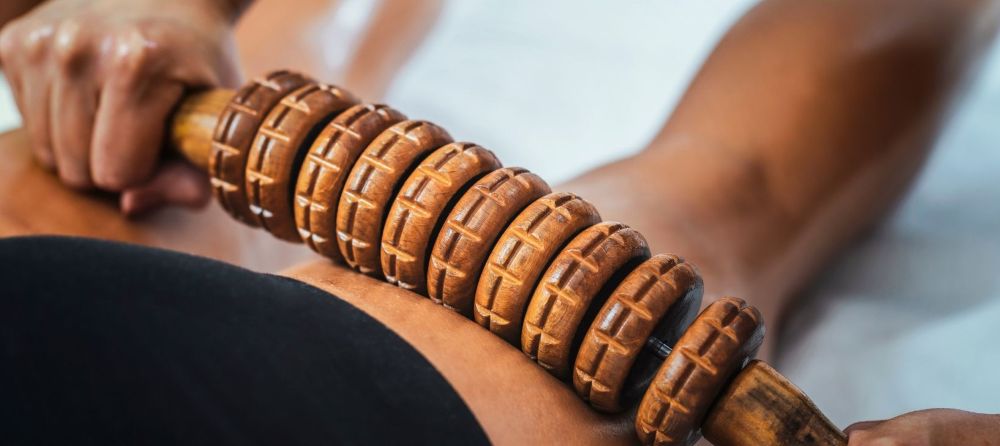
Here are the key benefits of wood therapy: